

Parent-metabolite models are widely used, with numerous examples available in the literature. For instance, Bertrand et al. (2011) evaluate parent-metabolite models of increasing complexity for the antipsychotic agent S33138, using Nonmem and Monolix.
Example model:
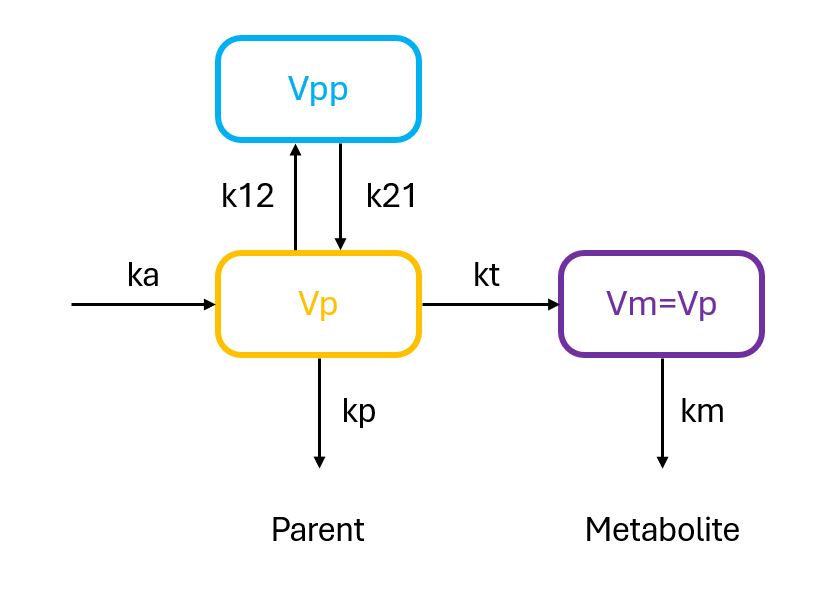
The parent compound is absorbed into a central compartment of volume Vp through a first-order process with rate constant ka, distributes to a peripheral compartment of volume Vpp with rates k12 and k21, and is eliminated with rate kp. It is also biotransformed into a metabolite via a first-order rate constant kt, with the metabolite eliminated at rate km. The metabolite's volume of distribution, Vm, cannot be identified and is therefore typically fixed to the volume of the parent's central compartment (Vm = Vp).
Additional complexity can be introduced into the model to capture saturation of the biotransformation rate or self-induced increases in metabolism over time.
This model is implemented in the Mlxtran language below:
[LONGITUDINAL]
input={ka, Vp, kp, k12, k21, kt, km}

PK:
depot(target=Apc, ka)

EQUATION:
odeType=stiff
t_0 = 0
Apc_0 = 0 ; Apc = amount of parent in central compartment
App_0 = 0 ; App = amount of parent in peripheral compartment
Am_0 = 0  ; Am = amount of metabolite

ddt_Apc = -k12*Apc + k21*App - kp*Apc - kt*Apc
ddt_App = k12*Apc - k21*App
ddt_Am = kt*Apc - km*Am

Cp = Apc/Vp
Cm = Am/Vp

OUTPUT:
output = {Cp, Cm}
The macro depot applies the doses from the data set to the ODE system. Here, doses are added to the amount of parent in the central compartment via a first-order rate ka, so there is no need to define a separate depot compartment in the ODE system. All other transfers are defined in the ODE system.
The first output element of the list (Cp) will be matched to the data with lowest OBSERVATION ID tag (OBSERVATION ID = 1 usually) and the second output (Cm) will be matched to the data with the second OBSERVATION ID tag (OBSERVATION ID = 2 usually). The odeType=stiff lselects and ODE integrator designed to solve stiff systems.
Demonstration of Vm Unidentifiability with Simulx
Unless the metabolite itself has also been administered, its volume of distribution, Vm, cannot be identified. This is because an increase in Vm can be compensated by a decrease in the biotransformation rate kt, which in turn can be compensated by an adjustment of the parent's elimination rate kp. The parent's disappearance (through elimination or biotransformation) is driven by ktot = kp + kt, so any combination of kt and kp values giving the same ktot will leave the parent's concentration-time profile unchanged.
To better illustrate this unidentifiability, the following Simulx exploration is proposed, where Vm is treated as a separate parameter.
[LONGITUDINAL]
input={ka, Vp, kp, k12, k21, kt, Vm, km}

PK:
depot(target=Apc, ka)

EQUATION:
odeType=stiff
t_0 = 0
Apc_0 = 0
App_0 = 0
Am_0 = 0

ddt_Apc = -k12*Apc + k21*App - kp*Apc - kt*Apc
ddt_App = k12*Apc - k21*App
ddt_Am = kt*Apc - km*Am

Cp = Apc/Vp
Cm = Am/Vm
A treatment element must be defined for the model, along with the output vectors for Cp and Cm. The exact amount administered is not important, so this example uses a single administration of 100 (units) at time 0. The output grid is set with a fine resolution, ranging from 0 to 150 with a step size of 0.1 for both prediction vectors.
A parameter element must be defined, containing the following values:
-
ka = 1 -
Vp = 10 -
kp = 0.1 -
k12 = 0.05 -
k21 = 0.05 -
kt = 0.02 -
Vm = 15 -
km = 0.01
With all these elements defined, the exploration can then be configured in the Exploration tab using this setup. Saving the configuration above the plots as a reference enables a comparison with the second parameter set, changing Vm=30, kt=0.04, kp=0.08
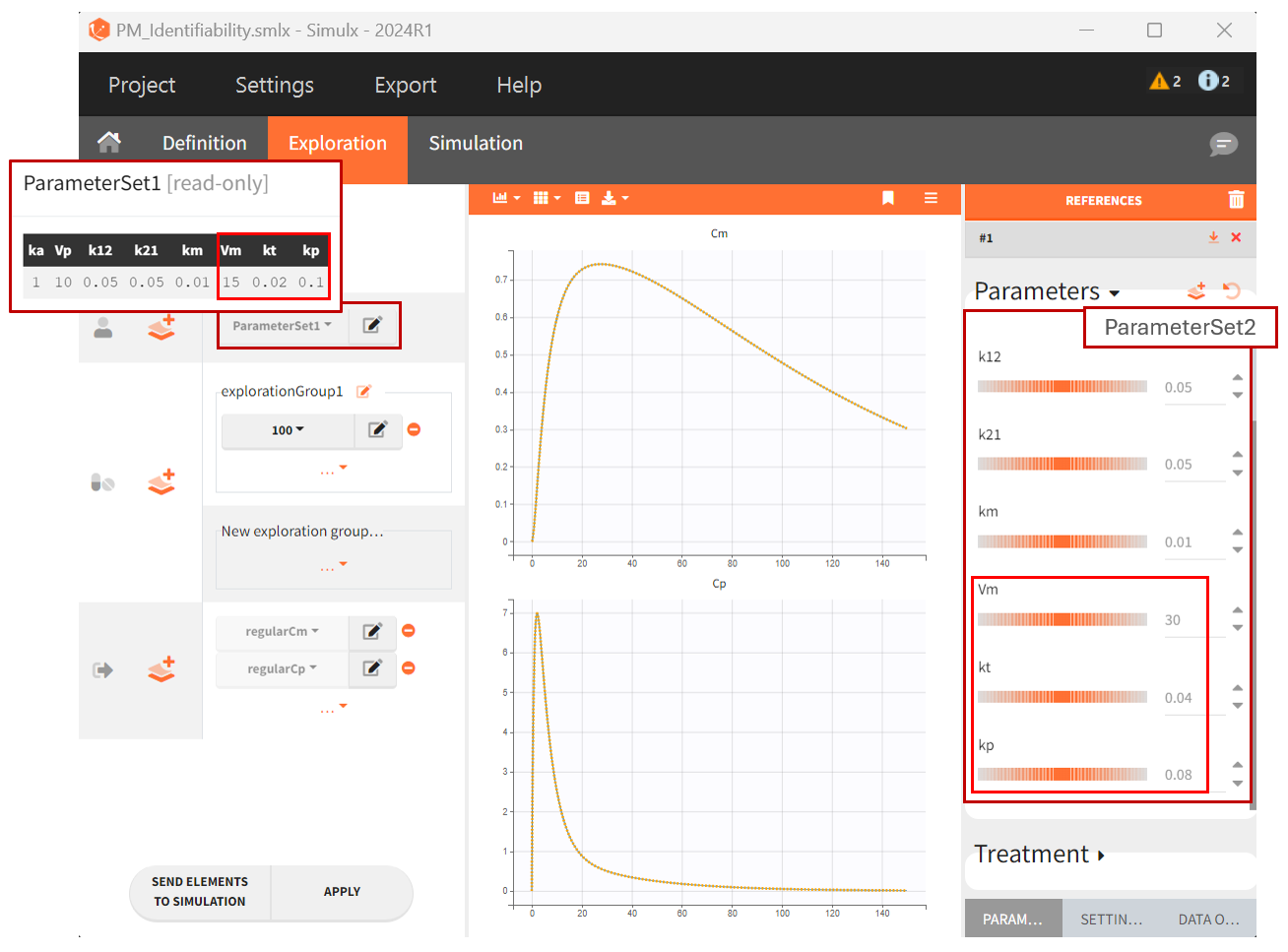
Different values of Vm, kt and kp can then be tested. The sets of values
-
Vm=15,kt=0.02,kp=0.1 -
Vm=30,kt=0.04,kp=0.08
lead to exactly the same prediction for both the parent and the metabolite, highlighting the unidentifiability. One of these three parameters must therefore be fixed, with the most common choice being to fix Vm to the value of Vp.