Monolix
Auto Light Dark
Auto Light Dark

Tree view

The panel on the bottom of the Hierarchy tab provides a schematic representation of the modeling workflow as a tree of projects. This graph diagram is built by the user and contains:

  • the name of the Monolix projects

  • changes from the parent project

  • the rating of the projects is displayed with a color code

As seen on the figure below, hovering on a node of the diagram highlights its parent in green and its child(ren) in blue, on the diagram but also in the Selection panel and the Table of runs. The path to the root node is also displayed in dashed blue line.
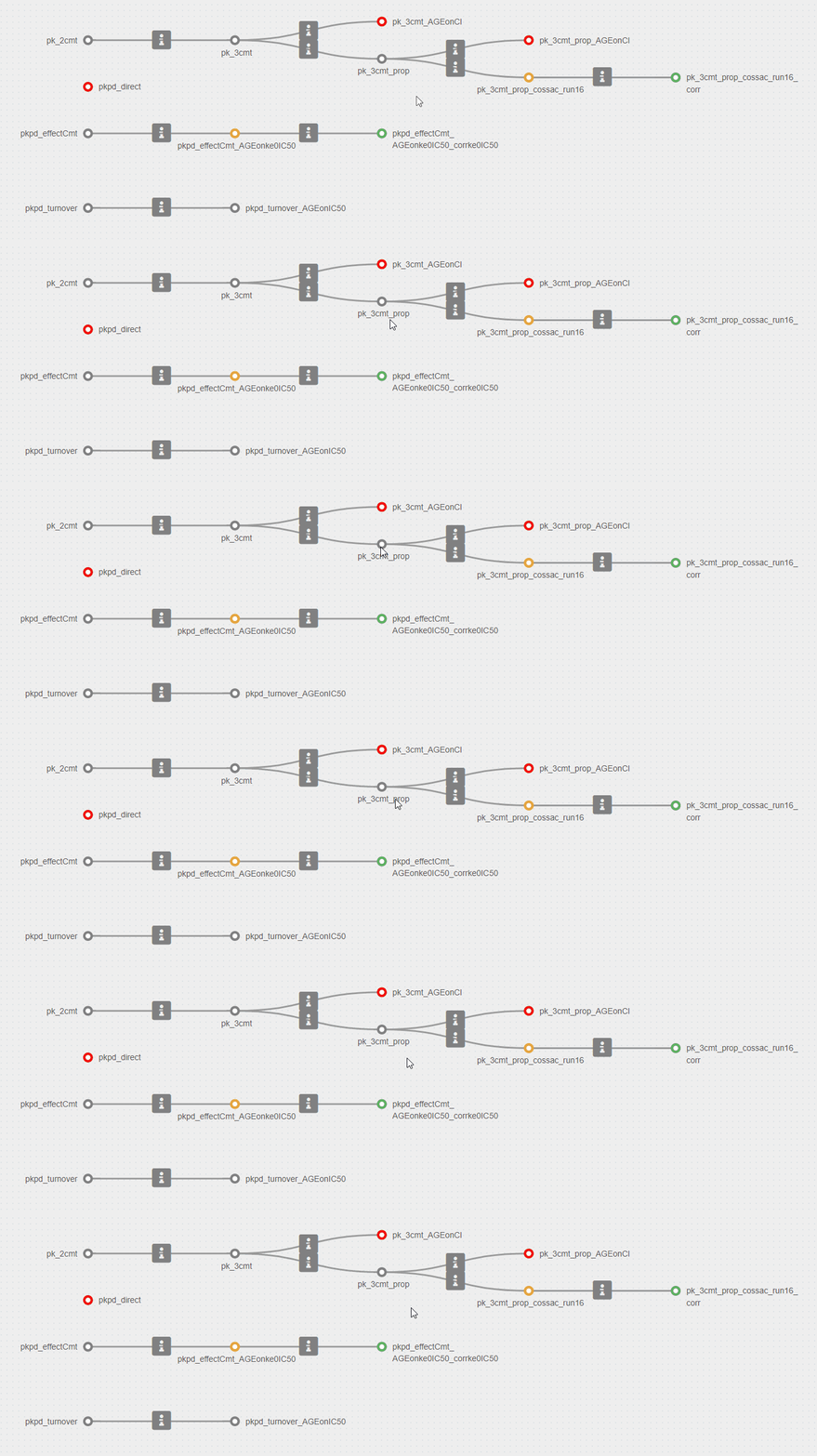

Animated Sycomore tree view of the modeling workflow. Project nodes such as pk_2cmt, pk_3cmt, pk_3cmt_prop, pkpd_effectCmt and pkpd_turnover are linked left to right by edges with info icons. Node circles are colored red, orange, green or gray by rating. The animation shows hovering a node, which highlights its parent in green, its children in blue and the path to the root.


Building the tree representation

To build the tree representation of your workflow, use the buttons “Add node to diagram” Gray circular plus icon, Add node to diagram button (shown below) in the table of projects to add relevant projects in the tree view.


Row of the Sycomore table of projects for pkpd_turnover_intermediate. The mouse cursor hovers the plus button in the Hierarchy column, showing the tooltip Add node to diagram, next to the action icons.


The projects are first added in the tree view as free nodes. They can be linked to a parent node via drag-and-drop. Available nodes are then highlighted in red, and the selected parent is highlighted in green, as on the following figure.
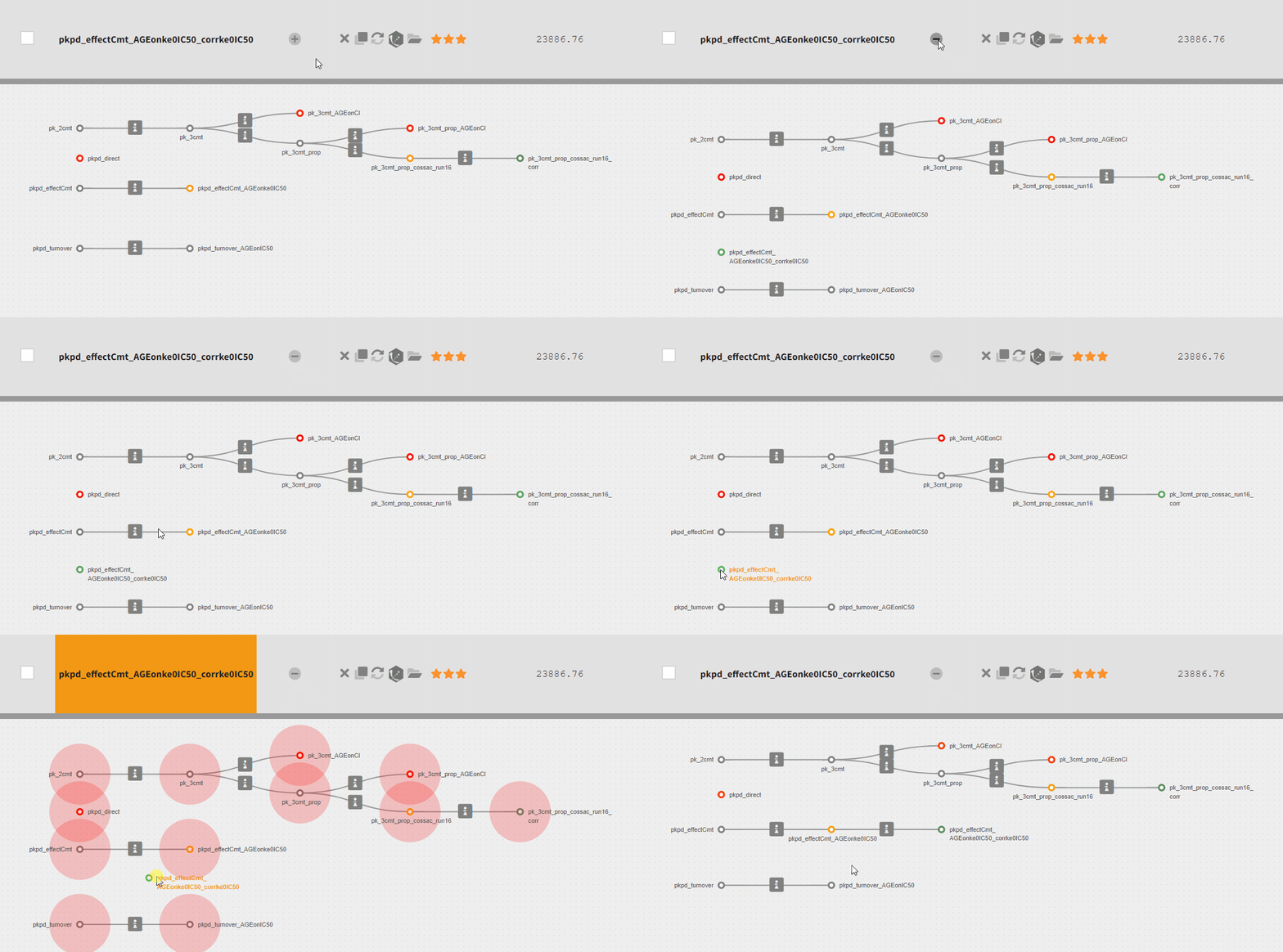

Animated Sycomore screen with the table of projects above the tree view. For the project pkpd_effectCmt_AGEonke0IC50_corrke0IC50, rated three stars, the Add node to diagram button adds it to the tree as a free node, which is then dragged onto a parent node.


Cloning a project allows to create a copy of the Monolix project with a different name, that can then be opened in Monolix and modified. A clone is automatically added in the tree view as the child of the cloned project.


Two-step Sycomore tree view figure. Left, right-clicking node PK_2, a child of PK_1, opens a menu with Remove node, Detach node, Clone project and Open project, with Clone project highlighted. An arrow points to the result, where a new node PK_2_clone is added as a child of PK_2.


Defining parent-child relationships

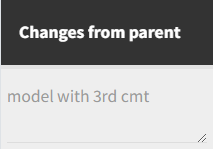
Changes from the parent project can be saved and displayed on the graph edges and in the table of projects.

Two ways to define a parent-child relationship

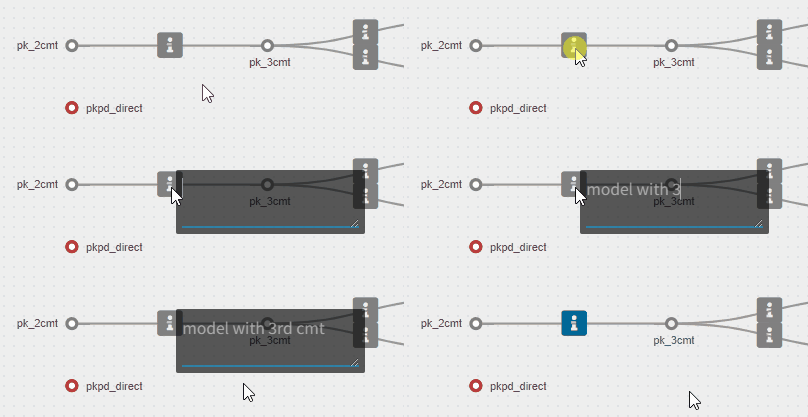
Display on hover


Animated close-up of the Sycomore tree view with nodes pk_2cmt, pk_3cmt and pkpd_direct. It illustrates defining a parent-child relationship between nodes, with an info icon on the edge between pk_2cmt and pk_3cmt.
Changes from parent column of the table of projects, with a text field reading model with 3rd cmt


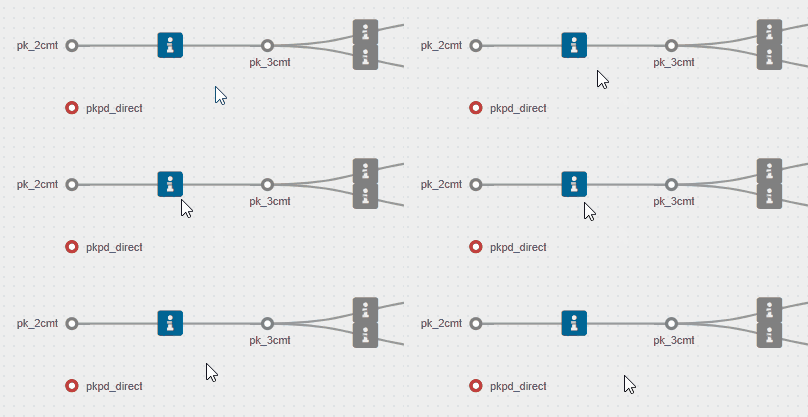
Animated close-up of the Sycomore tree view where the mouse hovers the info icon, highlighted in blue, on the edge between pk_2cmt and pk_3cmt, to display the saved changes from the parent project.


Display of rating

The rating of runs set manually in the table of project is displayed with a color code on the tree view: red for one star, orange for two stars, green for three stars.
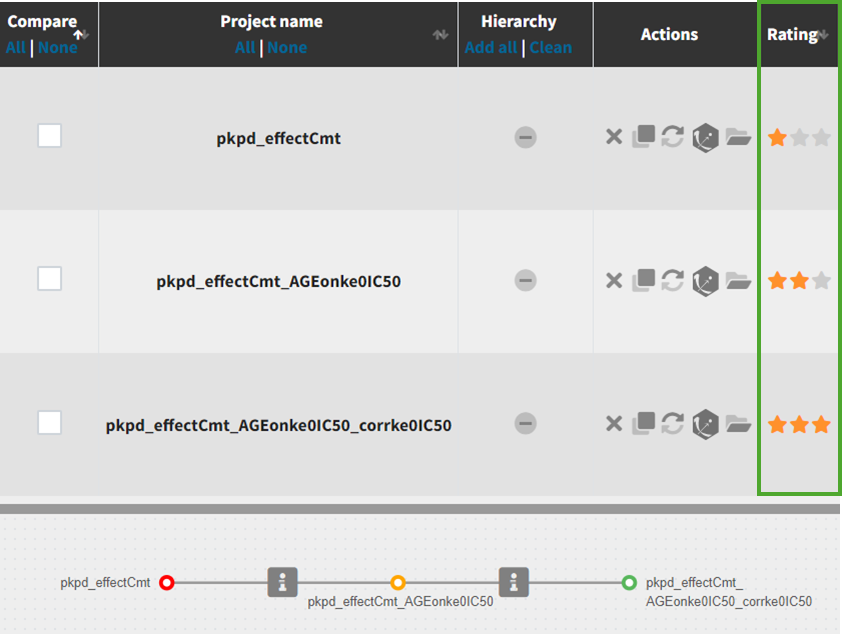

Sycomore table of projects with the Rating column outlined in green, showing one, two and three orange stars for pkpd_effectCmt, pkpd_effectCmt_AGEonke0IC50 and pkpd_effectCmt_AGEonke0IC50_corrke0IC50. Below, the tree view shows the same three nodes as red, orange and green circles.


Export

Starting from the version 2024, it is now possible to export the tree as an SVG file by clicking on the export button next to the tree. The exported tree will be the same as the tree in the interface, however it will not contain the information icons.
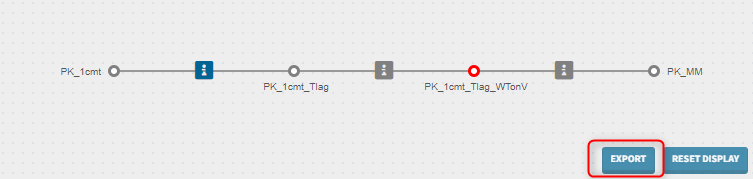

Sycomore tree view with a chain of nodes PK_1cmt, PK_1cmt_Tlag, PK_1cmt_Tlag_WTonV and PK_MM. The EXPORT button at the bottom right, next to RESET DISPLAY, is outlined in red.


Last updated: