

The best solution for Model Based Drug Development
Monolix is the most advanced and simple solution for non-linear mixed effects (NLME) modeling for pharmacometrics. It is based on the SAEM algorithm to provide robust, global convergence even for complex models and is equipped with a user-friendly interface to ensure a simple and fast workflow - from preclinical and clinical population PK/PD modeling to Systems Pharmacology.
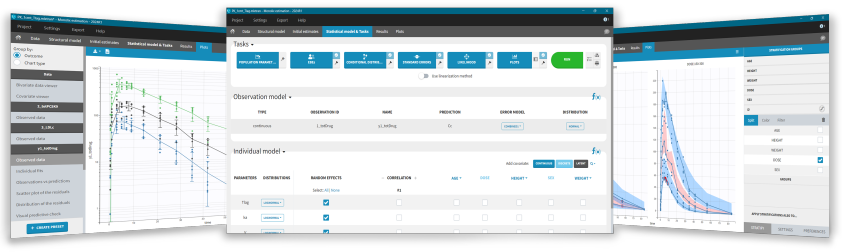
Key Features
Support of all relevant data types and statistical features for population PK/PD modeling. Monolix covers:
-
continuous, categorical, count and time to event data (or any combination);
-
inter-individual and inter-occasion variability (with any number of level);
-
automatic handling of BLQ data;
-
normal, lognormal, logit, probit and user defined distributions for individual parameters;
-
effect of covariates and correlations.
Mlxtran and model libraries.
Monolix provides a fully documented, open source, built-in model's library with more than 30000 models. Mlxtran, language for library and custom-built models, is a simple,
yet powerful, human readable language suitable for simple as well as complex models.
Automatically generated results and out-of-the-box diagnostic plots.
All results are displayed in formatted tables easy to copy in any document and are exported in the result folder in an R-compatible format. Full set of interactive diagnostic
plots is also automatically generated for straightforward interpretation of the results.
Comprehensive documentation and tutorial materials.
We provide a comprehensive online documentation that includes methodology, software manuals and tutorials. A wide collection of examples can be used as templates to start your own project. Regular online courses and webinars build a large user community.
Why Monolix?
Regulatory compliance: Accepted by regulatory agencies for submissions. It assures data integrity and reproducibility of results and includes integrated validation suite.
Easy-to-use interface: Can be used via a modern, user-friendly graphical interface. The workflow is simple and intuitive, with guided steps to go through all your project.
Efficient model building: Provides fast and robust model development with built-in
libraries for structural model and interactive settings in the GUI for the statistical model.
Advanced Statistical Methodologies: Assures proper handling of modeling and reliable convergence for all type of data thanks to pioneered implementation of the SAEM algorithm.
Out-of-the-box diagnostic plots: Generates automatically a full set of diagnostic plots ready for analysis. You can instantaneously create VPC plot and split it by any patient subgroups.
Powerful computing: Includes efficient C++ solver packages, and possibility to
script complex workflows in R using a dedicated R-API.
Interoperability: Allows for non-compartmental analysis and simulations via the built-in integration with PKanalix and Simulx