

Issues on MacOS
During installation of the 2023R1 version, error: “monolixSuite2023R1” cannot be opened because the developer cannot be verified
MonolixSuite is safe but has not been reviewed by Apple. You can override the security settings to install Monolix 2023R1 following these steps:
-
Open Finder
-
Locate monolixSuite2023R1.app where you have downloaded and extracted it
-
Control+Click the monolixSuite2023R1.app
-
Select Open
-
Click Open
Monolix2023R1 should now be saved as an exception in the security settings, allowing to open it in the future.
During installation, error: The compiler g++ failed with the following errors: xcrun: error: invalid developer path
-
make sure you have installed Xcode and launched it at least once
-
re-install MonolixSuite using administrator rights.
When loading any project or any structural model, error Cannot load the Mlxtran plugin…
First make sure that Xcode has been installed and opened at least once.
Then follow these steps:
-
delete all folders located in
/Users/<username>/lixoft/monolix/monolix2024R1/modules -
open the following file in a text editor (e.g TextEdit)
/Applications/MonolixSuite2024R1.app/Contents/Resources/monolixSuite/config/system.ini -
in the section [compiler], add:
linux/arguments=-arch x86_64 -
save the file
If the error persists, then additional compiler arguments needs to be specified in the system.ini file.
-
open the command line, run the following command and copy the clang path returned
arch -arm64 xcrun --find clang++ -
run the following command and copy the MacOSX.sdk path returned
arch -arm64 xcrun --show-sdk-path -
open the following file in a text editor (e.g TextEdit)
/Applications/MonolixSuite2024R1.app/Contents/Resources/monolixSuite/config/system.ini -
in the section [compiler], add:
linux\force= <path to clang>
linux\arguments=-arch x86_64 -isysroot <path to MacOSX.sdk>
Depending where Xcode is installed, this could for instance be:
linux\force=/Applications/Xcode.app/Contents/Developer/Toolchains/XcodeDefault.xctoolchain/usr/bin/clang++
linux\arguments=-arch x86_64 -isysroot /Applications/Xcode.app/Contents/Developer/Platforms/MacOSX.platform/Developer/SDKs/MacOSX.sdk -
save the file
When loading a model from the model libraries, Monolix closes suddenly (crash).
The root cause of this issue is currently under investigation. The workaround is to download and use the library models from here: library_models_2024.zip
When initializing the lixoftConnectors, error: zsh: killed arch -x86_64 /Library/Frameworks/R.framework/Resources/bin/R
This error is due to the library libxl.dylib not being signed. Starting from Tahoe version (26.x), signature checks have become stricter.
Option 1: if you have admin rights, you can sign the library yourself with
sudo codesign -f -s - "/Applications/MonolixSuite2024R1.app/Contents/Resources/monolixSuite/lib/libxl.dylib"
Then restart R and initialize the lixoftConnectors again.
Option 2: download the signed library to replace the unsigned one
-
Download the signed libxl.dylib library
-
Copy it to
/Applications/MonolixSuite2024R1.app/Contents/Resources/monolixSuite/libin order to overwrite the previous unsigned version of the library
When initializing the lixoftConnectors, error: Error in dyn.load(get("LIXOFT_CONNECTORS_LIB_PATH", envir = LixoftEnvironment)) : unable to load shared object […] (have 'x86_64', need 'arm64e' or 'arm64')
Because MonolixSuite has not been compiled for M-series arm64 architectures, you need to install and use the ‘x86_64’ version of R. You can install it from https://cran.r-project.org/bin/macosx/
Note that if you have several R versions installed, you can switch between different R versions in Rstudio by following these instructions: https://derailment.netlify.app/2020-06-26-switching-between-r-versions-on-mac/
When initializing the lixoftConnectors, R crashes with message “R session aborded”
Several users have reported this kind of crashes with recent versions of R and Rstudio. For the moment, the workaround is to revert to older R and Rstudio versions, such as R 4.4.3 and RStudio 2025.09.2+418.
When trying to open a project which was created on Windows, error: “Impossible to open file ‘dataset.csv’ in text mode.”
After opening the project created on Windows machine, the error message “Impossible to open file ‘dataset.csv’ in text mode.” may appear. To overcome this error, start MonolixSuite in the following way:
– right click on the application icon and click on Show package content,
– open MacOS subfolder inside Contents folder
– start MonolixSuite by double clicking on monolixsuite
Downloading MonolixSuite
My web browser claims that the Monolix download website has insufficient reputation and suggests to stop the download.
Some browsers like Google Chrome and Internet Explorer may ask whether to keep or remove the MonolixSuite archive just after download because of the insufficient reputation of the Lixoft website, simply because it is insufficiently referenced. Please ignore the warning and choose to keep the file. You can use a MD5 tool to verify that the downloaded file is not corrupted.
The MonolixSuite archive is removed just after being downloaded.
Some antivirus may consider the MonolixSuite archive as risky and put it in quarantine or remove it. This is due to the fact that MonolixSuite embeds a compiler for the Mlxtran language. Two solutions are available:
-
Deactivate your antivirus auto-protection process during download and installation, or
-
Restore the file from the quarantine.
To restore the file from quarantine, please refer to the documentation of your antivirus software. For the most common examples:
-
Norton Antivirus: In the Norton product main window, double-click Security, and then click History, then Quarantine.
-
Avast Antivirus: Open Avast, Choose Maintenance, then Virus Chest as explained here.
-
Mcafee Antivirus: Click Navigation (or click the cog at the top right), and click Quarantined and Trusted Items.
You should see the downloaded file among the quarantined files. Execute the Restore action; the archive will be restored into the directory used for downloading. Click on the archive (ignore a possible “malware” warning, again related to the fact that MonolixSuite embers a compiler.), and installation will start.
Installing MonolixSuite
When launching the installer, my antivirus tells me that the executable file stopped working.
Some antivirus may consider the MonolixSuite archive as risky and put it in quarantine or remove it.
The solution is the same as for the problem just above “The MonolixSuite archive is removed just after being downloaded.”
When initializating the lixoftConnectors, error “unable to load shared object”
On Windows: Having R package "zip" loaded before initializing the lixoftConnectors is the most common cause of the issue. This package is imported when loading the packages "openxlsx", "officer" or "flextable" for instance, and it prevents loading the dll needed to initialize lixoftConnectors.
The solution is to start from a clean R session and load and initialize the lixoftConnectors before loading any other package.
When using mlxR, I get an error “Error in xtfrm.data.frame(x) : cannot xtfrm data frames”
The error is coming from a change in the behavior of the function order() on dataframes in R version 4.3.
You can install from github the mlxR version 4.2.2, which is compatible with R 4.3 (see https://github.com/MarcLavielle/mlxR/releases/tag/v4.2.2).
When using the lixoftConnectors, I get an error “Error “computeSimulations is not an exported object from namespace::lixoftConnectors”
This error can happen when the lixoftConnectors, RsSimulx and MonolixSuite versions do not match.
library(lixoftConnectors)
initializeLixoftConnectors()
packageVersion("lixoftConnectors") # gives version of the R package
getLixoftConnectorsState()$version # gives version of MonolixSuite
# if RsSimulx is also used:
library(RsSimulx)
initRsSimulx()
packageVersion("RsSimulx")
To change the version of the lixoftConnectors R package, install it again using the .tar.gz from the installation directory of the MonolixSuite version you want to use.
To change the MonolixSuite version, initlialize by specifying the path of the version you want to use, e.g initializeLixoftConnectors(path="C:/Program Files/Lixoft/MonolixSuite2024R1").
In addition, note that mlxR is only compatible with MonolixSuite version up to 2019. Afterwards, RsSimulx should be used instead.
When using RsSimulx, I get an error “Error in do.call(rbind, paramOut) : second argument must be a list”
This error can happen when the lixoftConnectors, RsSimulx and MonolixSuite versions do not match.
library(lixoftConnectors)
initializeLixoftConnectors()
packageVersion("lixoftConnectors") # gives version of the R package
getLixoftConnectorsState()$version # gives version of MonolixSuite
library(RsSimulx)
initRsSimulx()
packageVersion("RsSimulx")
To change the version of the lixoftConnectors R package, install it again using the .tar.gz from the installation directory of the MonolixSuite version you want to use.
To change the MonolixSuite version, initlialize by specifying the path of the version you want to use, e.g initializeLixoftConnectors(path="C:/Program Files/Lixoft/MonolixSuite2024R1").
To change the RsSimulx version, install it from CRAN using (adjust version in URL):
packageurl <- "https://cran.r-project.org/src/contrib/Archive/RsSimulx/RsSimulx_2.0.0.tar.gz"
install.packages(packageurl, repos=NULL, type="source")
Running an application of MonolixSuite
I cannot launch any application of the MonolixSuite on Windows 11. A console opens and closes very quickly, and nothing else happens.
Strongly suggested: Download and install MonolixSuite 2023 (to be released end of February/beginning of March).
Workarounds: To keep launching MonolixSuite 2021 on Windows 11, you can one of these two options:
-
run the program as administrator by doing a right click on the application icon and “run as administrator”
-
modify the “.bat” files located in /bin folder of the installation folder (C:ProgramDataLixoftMonolixSuite2021R2bin by default) in the following way:
@echo off
cd %~dp0\..\lib
start "monolix" /B "monolix.exe" %1 %2 %3 %4 %5 %6 %7 %8 %9
ping localhost -n 6 > nul
cd %~dp0
This will force the console to stay open for a few seconds before it disappears, and the launch will work even without running as administrator).
When launching the standalone version, my antivirus tells me that some executable file is risky.
If your antivirus apparently removed an executable file, check if it was actually put on Quarantine, or removed. If it is in Quarantine, please restore it by following the same instructions as provided above. If the file was removed you will need to reinstall MonolixSuite. You should be able to add this file to your antivirus Trusted Zone or Trusted files.
In addition, you can define it in the trusted zone and thus not scan this folder.
When running a project, an openGL error appears
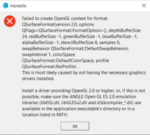
Disable the use of GPU:
-
in the file browser top bar, type: C:\ProgramData\Lixoft\MonolixSuite2021R1\bin
This should bring you to the “bin” folder of the MonolixSuite installation directory. -
open the file monolix.bat with a text editor
-
add the argument
--disable-gpusuch that the file content is now:
@echo off
cd %~dp0\..\lib
start "monolix" /B "monolix.exe" --disable-gpu %1 %2 %3 %4 %5 %6 %7 %8 %9
cd %~dp0
-
save the file
-
reopen Monolix
When launching an application of the MonolixSuite on Windows, I get the error “Cannot find cmd.exe in current system path”
If you get the following error message: Cannot find cmd.exe in current system path PATH, please follow the steps below to add C:/Windows/system32, which contains the cmd.exe executable, to the PATH.
-
from file browser, right click on Computer > Properties. You arrive in control panel > system and security > system.
-
click advanced system settings (on the left of the window)
-
click environment variables in the pop-up window
-
in the system variables, edit the Path variable:
-
add
C:\Windows\system32;at the beginning
-
save and retry
When trying to load any project, I get “Error during module building:Calling the build setup failed and returned” or “Cannot load the Mlxtran plugin at XXX.dll”
This message means that the compilation of the model has failed.
On Windows, the most common cause is special characters (including dots and spaces) in the windows session username or missing Write permissions in the folder where we generate the compiled model. To modify the path where the compiled model is stored, please follow this procedure:
-
Go the installation folder:
With version 2018-2023, by default C:\ProgramData\Lixoft\MonolixSuiteXXXX\config, where XXXX is the MonolixSuite version. ProgramData is usually a hidden folder, but it is possible to just copy and paste the path in the path bar at the top of the Windows Explorer.
With version 2024 and above, by default C:\Program Files\Lixoft\MonolixSuite2024R1\config
-
Open the system.ini file in a text editor such as WordPad or Notepad++.
-
Modify the [path] section in the following way:
[path]
enforced-modules-directory = C:/Temp/lixoftmodules
-
Close and reopen Monolix.
On Windows, Monolix crashes while generating the diagnostic plots
This can be due to the use of the GPU. Follow the procedure below to disable the use of the GPU (this should not impact performance):
-
Open the file monolix.bat located in C:\ProgramData\Lixoft\MonolixSuiteXXX\bin (where XXX is your MonolixSuite version) in a text editor
-
Add the option
--disable-gpuas shown below:
@echo off
cd %~dp0\..\lib
start "monolix" /B "monolix.exe" --disable-gpu %1 %2 %3 %4 %5 %6 %7 %8 %9
cd %~dp0
-
Save the monolix.bat file
-
Relaunch Monolix
Resolution and display
Remote access using direct rendering is not working
Our interfaces are using OpenGL technology. This implies that the remote access cannot use direct rendering (the OpenGL application sends instructions directly to the local hardware bypassing the target X server).
An indirect rendering should be used, i.e. the remote application sends instructions to the X server which transfers them to the graphics card. It is possible to do that with an ssh application, but it needs a dedicated configuration depending on the machine and the operating system. Other applications such as VNC or Remina can be used for an indirect rendering.
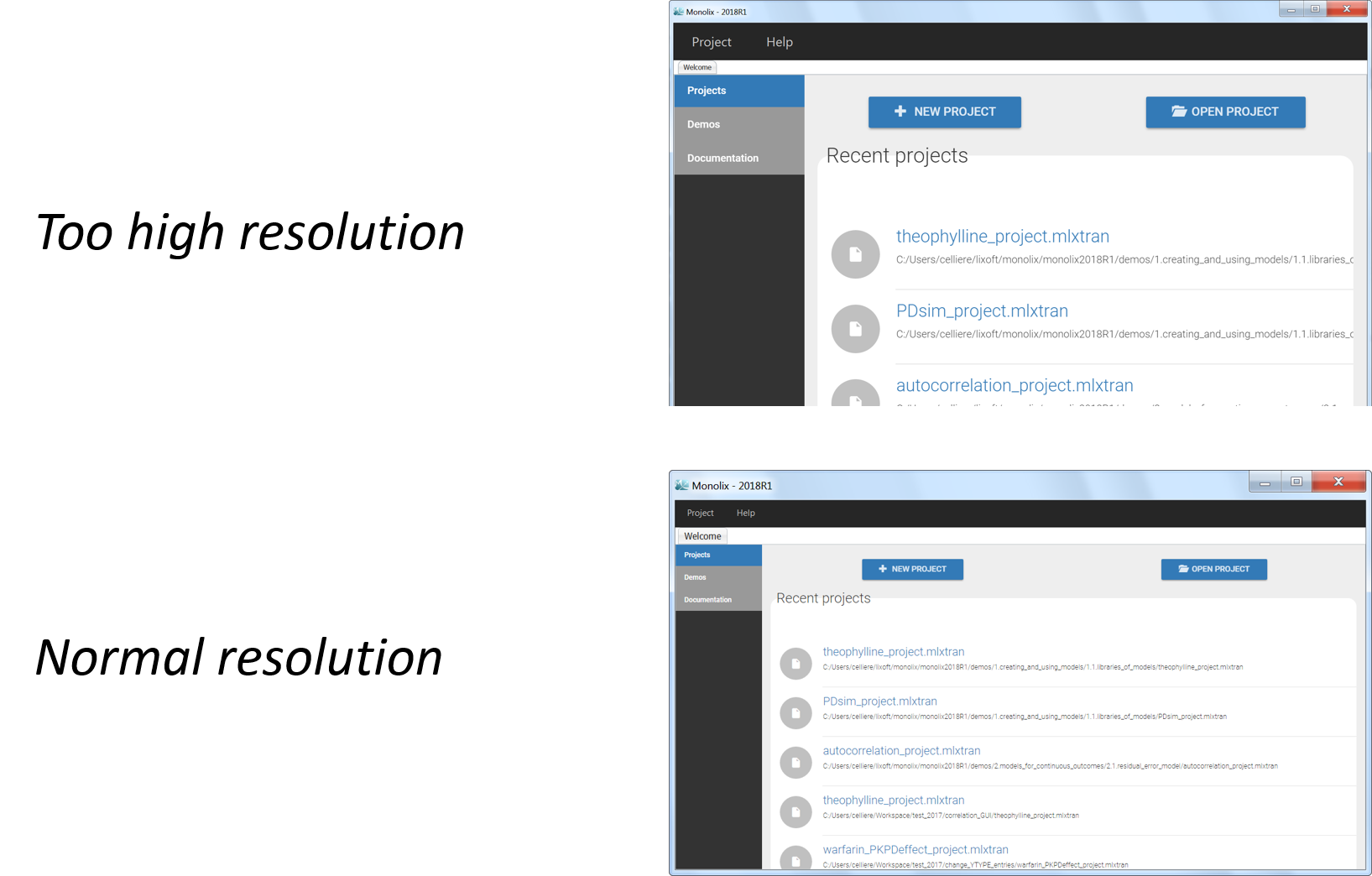
The graphical user interface appears with too high or too low resolution
-
open Monolix
-
load any project from the demos
-
in the menu, go to Settings > Preferences and disable the “High dpi scaling” in the Options.
-
close Monolix
-
restart Monolix
The Observed data plot or VPC plot is empty or with non-appropriate axis limits
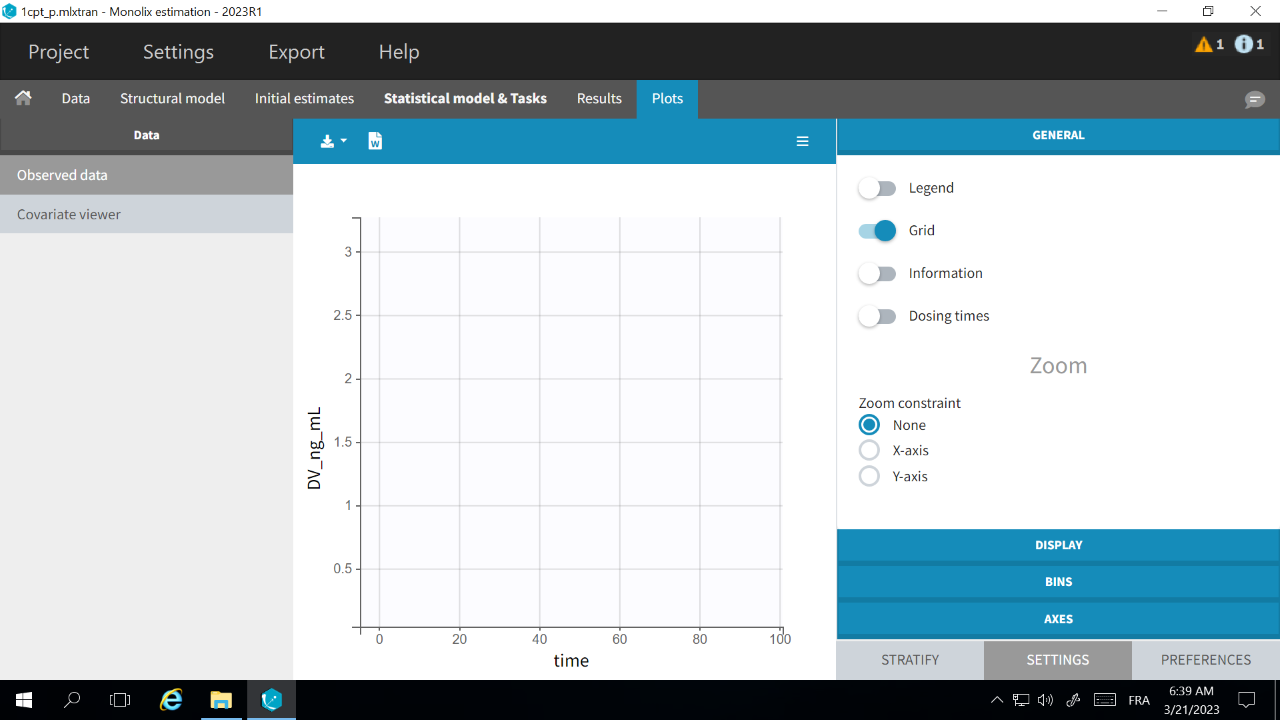
The problem appears after having clicked “Export > Export charts settings as default” on a previous project where the y-axis limits were different and this is now applied as default. It is possible to delete the default setting corresponding to the axis limits in the following way:
-
Open the file C:/Users/<username>/lixoft/monolix/monolix2023R1/config/settings.default in a text editor
-
Delete the following lines:
VPCContinuousyInterval= ... outputPlotyInterval= ... -
Save the file
-
Reopen your project